Friday, January 22, 2016

POST #113: SERVICE FOR FIFTY

When I was in graduate school, decades ago, my mentor was an aristocratic maiden lady whose father had owned one of the largest woolen mills in New Hampshire. She had taken me and my best friend, Joan, under her wing in a rather futile attempt to turn us into ‘gentlewomen’ (no small task.)  This often involved dragging us up to Westchester where she lived, to meet other aristocratic, elderly ladies living in “restricted” communities. They did things that were unheard of in my family such as “pour tea.” I never could fathom why learning how to pour was an important part of my education, but I went along for the ride.

My parents were Depression poor and largely self educated but what they lacked in status, they made up for in intelligence, curiosity and cultural sophistication They could read Tolstoy in three languages – they spoke at least five – could identify an aria from any opera or a quintet in A Major by Hayden in a split second. But ‘pour tea’? Not in their repertoire. They never taught me how to set a table properly (to this day I still don’t know how) or how to write an appropriate thank you card, but they did see that I studied piano with the man who taught Jasha Heifetz’s grandchildren and made sure I had weekly dance lessons with one of Isadora Duncan’s daughters.

It turned out that one of my mentor’s best friends was selling her house in Scarsdale, and, having no immediate heirs, offered to sell me the family silver for $250. The set included well over 500 pieces,of monogrammed sterling,  at least 50 place settings and serving pieces of unimaginable beauty. Why in the world she thought I could use all that cutlery was beyond me. At that time I was teaching art in a New York City high school, so I had the $250, but I had no idea  what would I ever do with so much silver – let alone clean it. I had no serious marital prospects at the time and, even if I had, he would most likely have been an impoverished musician or graduate student, no one ever likely to give sit-down dinners for fifty. I politely refused the kind woman’s generous offer ($250 was a steal, even in back then) but to this day, I still wonder if I made a mistake.

What still puzzles me is, what could possible constitute so much cutlery? Okay, I get the standard forks, knives, soup, dessert and coffee spoons. But then what? Oyster forks? Fish knives? Grape spoons? Etc. etc. No matter how I try, I can’t get up to a ten-piece setting. Nobody lives that way any more. (at least no one I know) and my family certainly never did.  It’s right out of Downton Abbey where unimaginably complex table manners were a way or keeping the ascending nouveaux riches from breaching the ranks of the upper class. You had to be brought up in an environment where ten-piece place settings were standard procedure; it was not something a suddenly rich tradesman could ever learn as an adult. I remember a story a friend (who came from a poor farming family) told me about being invited to a distinctly upper-crust dinner party and “using the wrong fork!!” Before anyone could notice his breach of etiquette, the butler had slipped up behind him, palmed the errant piece and replaced it with the correct one.


To this day, I avoid giving sit-down dinners. First of all, I don’t particularly like them - I hate being trapped next to a bore - and secondly, I’m never quite sure I get it right. I give great “artist” parties (no humility) but my aristocratic mentor, who tried so hard to make sure I had an appropriate set of silver for my married life, would have been appalled at the sight of a glass goblet containing forks.  

Friday, January 15, 2016

POST #112: WHAT’S GOING ON UP THERE? THE PARTY IN MY ATTIC

Readers who know me personally know that I live in a big old house, the kind realtors refer to as a “Handyman’s Special.” If you don’t look too closely, it looks pretty good, has lots of period charm, but close inspection reveals many problems, the least of which is the need for a second full bathroom and a laundry room. (Magic Touch Cleaners does my laundry; I recommend them highly).

Secondly, the house desperately needs a paint job, inside and out. The casual visitor, however, is so dazzled by my tag sale treasures, they rarely notice the peelings and the cracks. And last but not least, the house has a cesspool, not even a septic system, let alone city sewers. When we bought it fifty years ago, we were told, in all candor, the cesspool might fail and have to be replaced “at any moment.” The good news is, it’s still going strong

 Despite its faults, it’s a great old house. There’s a beautiful library with shelves made at a nearby mill from trees taken down when the Merritt Parkway was built. There’s a two-story artist’s studio (the previous owner was a mural painter) with a huge north light window and, as a bonus, a floor through, heated attic perfect for storing canvasses and the fifteen overhead projectors I keep just in case a bulb burns out and I can’t replace it.

It’s the attic I want to write about. I’m convinced that there’s a party going on up there every night. There are dozens of paintings stored in racks plus about twenty larger-than-life cardboard cutouts based on all the corrupt developers, lawyers and politicians I have been dealing with over the years - along with their wives, girlfriends, goons, etc. Since I haven’t come through with the performance piece I promised them years ago, I am convinced they put on plays of their own at night when I am asleep, A Brechtian theater ensemble in my attic! I’m especially suspicious when I see them in a different order than they were on a previous visit.
All in all, it’s a pretty lively crowd up there.

In addition, the low eaves at either side of the roof are perfect for storing things that don’t have much height. That’s where I keep the dozens of supermarket boxes I filled with satirical figures set in photocopied backdrops of pre Urban Renewal Stamford. Those are the ones an art critic once said that “if that’s what people actually look like,” she would “fall on her ballpoint pen.” I hate to tell her, but that’s what people actually look like.


Frankly, it’s ok with me if my creations want to party. I would prefer that they go out in the world, party in museums and galleries, but if that isn’t going to happen –at least in my lifetime  - then let them have a good time up there by themselves. I can sleep through anything!

Saturday, January 2, 2016

POST #111: FORM FOLLOWS F---- UP Or, The Scientific Principle of Limited Sloppiness


My sculptor son Ned and I got into a lively conversation a couple of nights ago on neatness in the workspace. The guys in his shop have a sign on the wall that says “Form Follows F----UP. Rosie, my blog helper, tells me the server who sends out my blog does not tolerate lewdness of any kind and will probably take me off line. Anyhow, the principle is pretty obvious: too much messiness and you can’t think straight; too neat and you inhibit creativity. I once walked out of an art teaching job (to scary unemployment) in New York City because the Principal of the school insisted that the room be perfectly neat at all times, no spilled paint, no paper scraps on the floor. Better “hand to mouth” I decided than to try to teach art in such an inhibiting environment.

Of course, the need for order varies from artist to artist and the nature of his or her work.  I’m somewhere in the middle of neatness: too much mess and I can’t think straight, can’t find anything. Too neat and the principle of “limited sloppiness” kicks in and I can’t create. There are artists, however, like the Dutch painter, Piet Mondrian, who lived in New York City during World War II. Mondrian was known for maintaining an immaculate studio in his apartment, coming to work every day wearing a suit and a tie, spending months on each painting, carefully moving a limited repertoire of shapes and lines around the canvas.

I find I work best (like most artists) in a state of middle neatness. I recently passed the threshold of acceptable messiness and was forced to hire someone to help me get “organized.” I won’t give out her name because she’s so busy she barely has time to help me. I learned my lesson with Felipe, my handyman, gardener, carpenter, canvas stretcher and “homme de ménage.” He’s better than a husband because you can tell him what to do. I made the mistake of sending him to a friend, who sent him to all her friends and now I have trouble getting him.


Anyhow, X got me organized in two afternoons. We took four carloads of waste matter to the dump, and I never missed any of it. I now need her again because the creepy crud is coming back. Nature abhors a vacuum. Her methods are simple: she is very autocratic, insists that I concentrate on what we are doing, doesn’t allow me to drift off into my usual creative revery. That’s the problem of trying to make order on your own; you get distracted. “Oh, that’s where such and such is! Let’s see what I can do with it”. The “neatanizer” snaps me back to attention and the job gets done. We still have half a studio to go (probably another four loads to the dump?) but she has been too busy to get to me. Apparently, there are lots of artists around who desperately need her services.” While there’s truth to “form follows f---- up,” the problem is getting one’s workplace to the point whereyou can create without distraction …(and keep it there!) 

Friday, December 18, 2015

POST #110: TO CRITIQUE OR NOT TO CRITIQUE

My artist friends rarely ask me to critique their work and I never offer anything more than ”Gee. That’s great! I like what you’re doing!” On the rare occasion when I am directly asked, I hem and haw and mutter platitudes. I just don’t feel I have the right to impose my vision on someone else’s work. I also don’t like other people telling me what to do. The last time I listened to an artist friend, it took six months to undo the damage. The only exception is my friend Elena who can actually take a brush to my canvas and make it better.


Teaching art in general is a treacherous business. You can learn the basic techniques in a couple of hours, but the remaining time you need to become proficient has to be done on your own. When we first moved to Fairfield County, decades ago, there were at least a half dozen hunky older men who taught bored housewives “watercolor.” All their students’ work looked alike, a bag of tricks taught to them by their mentor. Mostly, the guys were serial seducers; while it was amusing to watch them in action, it was  hard to consider them serious artists or art teachers.

The only one I knew who had any idea of what he was doing was a Hungarian emigre painter named Victor Candell. He wasn’t a particularly good artist himself but he was a master teacher, the Sigmund Freud of the suburban art scene. He taught a weekly seminar at the Greenwich Arts Center to a bunch of conservative matrons desperate to find their inner creative souls. I was the oddball in the class; I had actually studied art, but after being a ‘stay-at-home’ mom for several years, needed some help getting back up to speed. Candell taught me what abstraction really meant (I had been painting “Abstracts” for over a decade with no idea of what I was actually doing). I would never be doing the work I’m doing now without his guidance so many decades ago.

Anyhow, what brings this all to mind is an image a friend recently sent me of her latest work, an excellent example of Action Painting. She asked me to critique it, something I rarely, if ever, do. What could I say that would be helpful, not throw her off track the way someone had done to me decades ago?  After pondering a while, I realized what she needed to do and rather than my telling her, she had to get there on her own. The only way for that to happen was for her to work, day in and day out, until her conscious mind no longer controlled her hand and her subconscious, with all the suffering she had been through in her life, came through in her art. I gave her the example of Rothko who managed to infuse abstraction with intense emotion. That was where she needed to go, but I couldn’t tell her how; she had to get there on her own.

By the way, my suggestion that she plumb her emotional depths puts her completely out of step with the current art world.  There are no serious painters of note today. Everything is a gimmick, a spoof, a take off, a marketing ploy. If you want to know where today’s artists learned their craft, I recommend Sarah Thornton’s book of essays, Seven Days in the Art World, published in 2008, The piece de resistance is The Crit which describes a seminar at CalArts in Los Angeles, (one of the top art schools in the country) in which MFA students present their work for collective critique. I’m not going to tell you what happens; you have to read it for yourself, especially if you want to understand the current scene.


Anyhow, the bottom line is, I really hesitate to critique or advise anyone; I have enough trouble managing myself.  Can you imagine Cezanne asking Bonnard whether he should keep on painting apples? Maybe try pears?

Friday, December 11, 2015

POST #109: IT’S ALL IN MY STARS

I’m a typical Libran and I can’t make up my mind. I keep weighing pros and cons, should I or shouldn’t I? The only reason I ever got married is that a man came along (a Taurus) who took matters into his own hands and made the decision for me. After our third date, he announced that we were going to San Francisco on our honeymoon. No wiggle room there. He was a psychologist, not an astrologer but, without even knowing my “sign”, he knew what needed to be done. If he had left it to me, I’d still be deciding.

What’s so interesting is that for many years most of my women friends were Librans (born September 23 to October 22nd), in fact, two of my best friends had the exact same birthday, September 29th and several others were a week or two apart. We often had a Libra birthday party together and were remarkably similar in personality and interests. Of course, I don’t believe any of this. I didn’t believe in Tarot either, but a year and a half ago, when the Tarot card reader in California suggested I write about art, I started this blog and it was the best advice I ever received!

Most of the Librans I know are nice people; we’re very attractive to men (not to brag) and confident (ahem). The only problem we all have is this damn indecisiveness. Always weighing the pros and cons and having a terrible time making a decision. I need to make two major business decisions in the next few months and am struggling. I even wish I had a man around to make them for me; that’s how desperate I am!

The other problem we Librans have is that we have to keep our lives (scales) balanced and will go to great extremes to avoid conflict or disruption. When my life is in balance, I fly; when the scales are out of kilter, I can’t function. Since this is theoretically an “art” blog, this brings us, obviously, to the Principles of Design, the course every art student takes at the very beginning of his or her training). We are taught that a work of art needs to be “balanced,” however, unlike a math problem or an algorithm, there is no correct answer; it’s all intuitive, not mechanical. But a work of art,  like a seesaw, won’t work properly unless it is balanced, whether symmetrically or asymmetrically, either way, doesn’t matter. It seems to be intuitive, unexplainable, built into our DNA. I can look at a painting or a photograph and “know” immediately whether it is balanced or not. Maybe, all it needs is some more dark paint in the right-hand corner. Ah! Now it’s “right”.

Anyhow, let’s go back to Librans. Perhaps there is some perfectly good scientific explanation why we share personality traits. Maybe it’s as simple as being born a certain time of the year; as the days grow colder and shorter, more time is spent bundled up indoors. There’s a certain amount of hibernation that takes place in the months following our birth and maybe this causes changes in our neurological structure? Someday, science will solve the mystery of astrology and it may turn out to be the weather on earth, not the alignment of the stars. 

Friday, December 4, 2015

POST #108: STUCK IN A STYLE


 One of the problems (which I fortunately don’t have to face) of being successful in the art world is that you get stuck in a style. The examples are legion of dealers asking artists to stay with the work that sells. Don’t blame the dealer; it’s a business to him. He’s not interested in the artist’s immortal soul; he just wants to pay the rent. There’s nothing worse that being told to do “another” painting like the one you just finished because there’s a customer for it. If that’s okay with you, then you should consider yourself a commercial artist, a perfectly legitimate trade, where you know from the getgo that you are providing a product and the buyer is determining the nature of the product. Most artists I know look upon a painting as a problem to be solved and once having solved it, are reluctant to keep repeating themselves.

On the other hand, most great artists loved variations on a theme. Like Mondrian, Cezanne, Monet; once they got something going, they were perfectly happy to explore it the rest of their lives. There are some artists, however who create problems for their dealers by wanting to stop painting the work the collectors want and move into new territory. Jackson Pollock was the perfect example. It’s sad when a successful artist gets boxed in my his success: mortgages, employees, property in Majorca, wives, ex-wives, disturbed children, all take their toll. Selling is no longer an option; it is a necessity….and that’s the end of any change or growth. They become captives of the market and their work deteriorates. Of course, like Basquiat or Modigliani, some artists solve the problem of repeating themselves by dying young, before boredom sets in.

This is a long-winded way of getting to the subject of today’s blog. If you haven’t been to my studio lately, you are in for a big surprise. The ditzy ladies, the corrupt politicians, the sultry sirens, the greedy developers have all been replaced by a kind of serene surrealism. That’s because I am finally moving away from my “day job” as a preservation consultant. I still plan to write a newsletter, but I am done with the battles. However, it was the battles that gave me subject matter, my “edge” and without them, I don’t feel the need for social criticism. The same thing happened to George Grosz when he fled the Nazis and came to America. He loved it here. He lost his raison d’etre and. I, having lost my “opposition” have retreated from reality into the unconscious. I’m now painting dreamy surrealist streetscapes, the kind of work people actually want to LIVE with. Although this is not my goal (never has been), I have been selling most of my recent work and find myself trying to talk people out of buying so I will have something for future shows. I tell them to tape their names on to the back of the canvases so they can claim the pieces later. My prices are still pathetically low (I’ve never been good at business) but before, I couldn’t give the work away. While people may have admired the old, satirical paintings as “art,” they didn’t want to be reminded in their living rooms the foibles of a corrupt society (which it still is) and that success usually goes to the least worthy among us, not the best.

I like the fact that as my life has changed, my artwork has changed with it. Every once in a while, I find myself going back to satire: pulchritudinous females, corrupt real estate developers and politicians. The results make me smile, but there isn’t the need for “revenge” any more. My head is literally in the clouds, painting imaginary cities that float in space. 

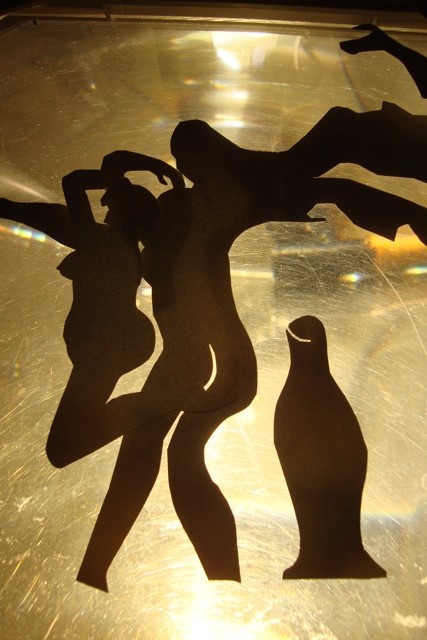
P.S. In bed at night, watching TV, I cut figures out of black kraft paper and in the morning, paste them onto paper plates (“Arte Povera” style) or put them on the overhead projector where they can be enlarged to monumental size. I have nothing to sell, but they are so breathtaking, I don’t care.
I haven’t missed a meal yet. 

Saturday, November 21, 2015

POST # 107: BREATHE!

I don’t have to tell my readers, life is full of distractions. When was the last time any one of us had more than ten minutes to think without a text message coming through, a phone call or an e-mail that HAD to be answered AT ONCE!
Creative thinking requires concentration. You need to get into a state (now fashionably referred to as “flow”) where ideas filter through the unconscious mind and come out in new forms. I am often asked what I listen to when I am painting and my questioner is usually surprised to hear “Nothing. I require total silence.” There’s no such thing as “background noise” to me; any noise, especially the human voice, is a distraction.

Do I get lonely? Sure, but not while I’m working. I have to get into a creative zone before anything new and interesting emerges and that requires time and isolation. It might take a couple of hours before my hand relaxes enough to turn out something worthwhile. I have no idea how someone can paint in a communal art studio where you hear other people’s conversation and music. At least, I never could. The best solution I know is the old Paris café where artists worked in solitude, (often, like Chagall and Picasso, locking their doors against visitors) and then spent the evening chatting with friends and colleagues. Studio visits (if any) were carefully planned so as not to disrupt “the flow.”

We live in a world of multi-tasking, another way of describing doing many things, not AT once – that is physically impossible - but rapidly switching from one activity to another. In addition, we are subject to endless distractions and become easily addicted to our electronics. You have only to watch people at a party sneakily checking their iPhones while appearing to converse with you. What are they expecting that can’t wait an hour or so? An invitation to be Cinderella at the Ball? It takes enormous discipline (which I don’t have) not to check my e-mail with ever increasing frequency. We start out being “connected” for good reasons: young children alone at home, your spouse needs to be picked up at the train, etc. and before you know it, you are hooked, an electronic junkie!

I find it interesting that  “mindfulness” and “meditation” classes are so popular nowadays, teaching people how to turn off the babble in the brain and just shut down. When the mind begins its chatter, you are told to “let it go,” empty your consciousness of thoughts and worries. “Breathe,” the teacher says, “Breathe.” It’s amazing how relaxing it is to just sit and breathe in and out; you become aware of how tense and ‘wired up’ you are. In one of the articles I read before writing this blog, the author suggested just letting your tongue hang out for a minute or two. She admitted you would look ridiculous, but said it was a great way to unwind. I may give it a try. If not, I’ll just “breathe.” The world isn’t going to miss me while I’m catching my breath.


P.S. During the hour or so I spent writing this, I received four phone calls, three from telemarketers. I didn’t answer any of them, but it was hard to get back my flow. Next time, I’ll turn everything off (or at least, I’ll try).