Friday, February 26, 2016

POST #116: KEEPING THE DOG ON THE PORCH or Sex in the Suburbs

There’s an old Southern expression that was used to describe Bill Clinton when he was Governor of Arkansas: “He’s a hard dog to keep on the porch” meaning of course his well-known tendency to philander. It’s a great way to describe a serial wanderer, but it doesn’t explain why the dog can’t stay “on the porch.” Is it constitutional, part of his genetic makeup? or is it that the porch is boring? Not enough going on to keep him there.

It got me thinking about all the couples I knew during my fifty years of marriage, some of whom wandered off the porch; most of who did not. The odd part was that it was usually the women who strayed. Most of my women friends were artists of one form or another, creative types, while their spouses were often engineers, accountants, doctors; steady and reliable, but boring as all hell. My sweet husband used to say (with a sad shake of his head), “No man is ever completely safe, but I’m about a close as they get.”  He was also quite large and unpredictable and no one ever dared come near me.  There was of course, one exception but I take no particular pride in that conquest because he tried to seduce all his wife’s friends. Since he was very attractive and macho, (a former Israeli commando), he had no difficulty enticing them until his wife (still my friend) decided she had enough and threw him out. The irony was, that since I never succumbed, he became a friend and treated me forever and ever with the utmost respect.

The women I knew, however, were an adventurous lot. Most were monogamous like their husbands, but there were several who loved to have scandalous affairs; in fact, the scandals were probably more interesting than the liasons themselves. Two close friends had well-publicized dalliances with prominent local officials. They made sure to tell everybody in town their “secret’; after all, what was the point of having an affair if the world didn’t know about it? (I’m surprised they didn’t take out ads in the Advocate). I never heard their husbands complain, so, for all I know, they were proud that their wives were so desirable - and that was what held their marriages together. It certainly gave all their friends lots to talk about. One of them had a lover who died (at home, with his wife, in his own bed) just hours after spending the afternoon with her. While she was wailing about her loss, I tried to explain how lucky she had been; if his heart had given out just a few hours earlier, we would have had our local version of the death of Nelson Rockefeller.

Although if took me years to catch on, my best friend, a glamorous European sculptress was always having love affairs. She never said a word about any of them and I only realized what was going on when I started to question all those phone calls she had to take “out of the room.” She was very wise about men, how to find them and keep them around. She gave me an insight I still find useful: “Women think men are after them for sex, but what they really want is a “warm bed.” She knew that what kept a man in your life was affection and caring: feeding (she was a great cook), loving and listening to him; what she wisely called ‘a ‘warm bed.’

…..And maybe that’s the way to keep the dog on the porch….although in Bill Clinton’s case, I don’t think anything would have worked.


Friday, February 12, 2016

POST #115: YALE & TOWNE REVISITED

Over a year ago, back in Post #31, I wrote about how I discovered the former Yale & Towne factory site in the South End of Stamford and how the loft colony there developed.  I recently “reconnected” with one of the artists, the photographer Bob Baldridge. He lived (illegally, of course) in a dream loft on the top floor of one of the buildings along Henry Street, next door to Jamie Burt, a potter/sculptor who occupied most of the 6th floor. There were even more interesting, older structures along Pacific Street but they were uninhabitable and torn down in the 1980s soon after I arrived. The photos now being exhibited at Curley’s Diner on West Park Place date back to the late 1970s and show the way the site looked when the artists first moved in, before extensive demolition took place.

In those early days, only men lived in the complex; the neighborhood was just too dangerous for a woman and even the men kept their doors locked and rarely ventured out after dark. Drug dealing and robberies were not uncommon. The women who had studios there  were careful about coming and going, often keeping a dog for protection. I had an office for my preservation organization on the second floor, with huge, industrial-sized windows that looked out over a row of Victorian cottages on Henry Street. We even had room for a twelve-foot sideboard we had salvaged from a demolished house that once belonged to Lowell Weicker’s grandparents. One of the things I came up with while I was there was a yearly Open Studios weekend where literally thousands of people came to gape at SOHO in Stamford.

Between the ambiance, the light and the camaraderie, it was the closest thing to artist’s heaven I expect to achieve in my lifetime. It ended for me when the landlord, upon hearing that I wanted to have the complex listed on the National Register of Historic Places, refused to renew my lease. The irony was that the next owner was eager to have the complex listed so that he could use the Investment Tax Credits the government gave for rehabilitating historic buildings.


Baldridge and I were recently reminiscing about a party we gave at his loft. He had a girlfriend at the time who was considering becoming a chef and opening a restaurant. Bob offered her a chance to see what it was like to cook for a crowd and we arranged a spaghetti dinner to be held in his loft. He had a small, but functional kitchen and a couple of big pots. I drew up an invitation; we borrowed chairs and tables and Bob put out the word:  Loft Supper, $5.  - all the spaghetti you could eat and all the (cheap) wine you could drink. The party was a huge success; in fact, it was too huge a success. Close to seventy people showed up and we were overwhelmed. (We should have taken reservations!) They were lined up in the halls. The water for the spaghetti wouldn’t boil and dinner didn’t get served until well after midnight. However, with unlimited wine, everybody seemed happy to wait while Bob’s friend worked frantically in the kitchen. People still talk about it today, but it was not a success we wanted to repeat. 

Friday, February 5, 2016

POST #114: CONCRETISM AND OTHER BULL----

I was recently invited to an all-day seminar on Concretism (and Post Concretism) at the City University of New York. I confess the term escaped me and at first I thought it meant sculpture made out of concrete. Picasso did some great work with it and my friend Cici has filled her garden with little cement men attached to rocks. Of course, I googled it and it turns out Concretism (and Post Concretism) were popular movements in South America in the late 1950s and early ‘60s. No wonder I had never heard of it: I was busy changing diapers at the time with three children under the age of five. I was lucky I remembered my own name, let alone the avant-garde movements of the art world.

I Googled the topic (how did we live before Google?) and discovered it was a bona fide movement that had nothing to do with cement but was a form of non-objective art, contemporary with Minimalism, hard-edge, color field, etc;, all those movements which did away with anything figurative  in favor of complete abstraction. It was an art of shapes, lines and colors that grew out of earlier 20th century experiments in “pure” painting by Kandinsky, the Russian Constructivists and Suprematists and the de Stijl movement in Holland, new art for a new world order. The abstraction that appeared in the ‘50s came from a totally different place, one of political avoidance and safety; no message was the right message in an era when McCarthy terrorized the country, what could be safer than a grid of lines? It’s Brazilian counterpart, Concrete Art (according to Google) was able to flourish “because it held no political messages or incendiary material” (as opposed to the “propaganda”  murals of Orozco or Diego Rivera.)

Meanwhile, in researching Concretism (and Post Concretism, an offshoot) I got the usual unintelligible artspeak. It has probably suffered in translation but what the hell does this statement outlining the difference between the two movements mean?

While Concretism built its art upon the basis of logic and objective knowledge with color, space, and form conveying universalism and objectivity, the Neo-Concrete artists saw colors, space and form as “not belonging to this or that artistic language, but to the living and indeterminate experience of man.” Monica Amor, 1959


It reminds me of an experience I had many years ago when the Whitney Museum had a branch in the Champion Paper building in Stamford. I went to hear a lecture by a prominent art historian. I forget what generally unintelligible topic it was, but one phrase stuck out as totally unfamiliar. He referred to something as  “anarchic formalism,” an oxymoron I had never heard before.  I waited until the clutch of sychophantic ladies finished telling him how wonderful he was (they hadn’t understood a word of his talk) and quietly went over and asked him what it meant. At least he had the decency to blush when he confessed that he had made it up because it “sounded good.” He figured no one in that audience of suburban boobs would know the difference.

And so Dear Reader, beware of art babble. If you don’t understand something, chances are the writer doesn’t understand it either. When I taught Art History, I used to begin my semester by asking the class to read a passage from their text. “What does it mean??” I would ask. No hands would go up. “Guess what?” I would say, “I don’t understand it either. The writer is just filling up the page.”


Friday, January 22, 2016

POST #113: SERVICE FOR FIFTY

When I was in graduate school, decades ago, my mentor was an aristocratic maiden lady whose father had owned one of the largest woolen mills in New Hampshire. She had taken me and my best friend, Joan, under her wing in a rather futile attempt to turn us into ‘gentlewomen’ (no small task.)  This often involved dragging us up to Westchester where she lived, to meet other aristocratic, elderly ladies living in “restricted” communities. They did things that were unheard of in my family such as “pour tea.” I never could fathom why learning how to pour was an important part of my education, but I went along for the ride.

My parents were Depression poor and largely self educated but what they lacked in status, they made up for in intelligence, curiosity and cultural sophistication They could read Tolstoy in three languages – they spoke at least five – could identify an aria from any opera or a quintet in A Major by Hayden in a split second. But ‘pour tea’? Not in their repertoire. They never taught me how to set a table properly (to this day I still don’t know how) or how to write an appropriate thank you card, but they did see that I studied piano with the man who taught Jasha Heifetz’s grandchildren and made sure I had weekly dance lessons with one of Isadora Duncan’s daughters.

It turned out that one of my mentor’s best friends was selling her house in Scarsdale, and, having no immediate heirs, offered to sell me the family silver for $250. The set included well over 500 pieces,of monogrammed sterling,  at least 50 place settings and serving pieces of unimaginable beauty. Why in the world she thought I could use all that cutlery was beyond me. At that time I was teaching art in a New York City high school, so I had the $250, but I had no idea  what would I ever do with so much silver – let alone clean it. I had no serious marital prospects at the time and, even if I had, he would most likely have been an impoverished musician or graduate student, no one ever likely to give sit-down dinners for fifty. I politely refused the kind woman’s generous offer ($250 was a steal, even in back then) but to this day, I still wonder if I made a mistake.

What still puzzles me is, what could possible constitute so much cutlery? Okay, I get the standard forks, knives, soup, dessert and coffee spoons. But then what? Oyster forks? Fish knives? Grape spoons? Etc. etc. No matter how I try, I can’t get up to a ten-piece setting. Nobody lives that way any more. (at least no one I know) and my family certainly never did.  It’s right out of Downton Abbey where unimaginably complex table manners were a way or keeping the ascending nouveaux riches from breaching the ranks of the upper class. You had to be brought up in an environment where ten-piece place settings were standard procedure; it was not something a suddenly rich tradesman could ever learn as an adult. I remember a story a friend (who came from a poor farming family) told me about being invited to a distinctly upper-crust dinner party and “using the wrong fork!!” Before anyone could notice his breach of etiquette, the butler had slipped up behind him, palmed the errant piece and replaced it with the correct one.


To this day, I avoid giving sit-down dinners. First of all, I don’t particularly like them - I hate being trapped next to a bore - and secondly, I’m never quite sure I get it right. I give great “artist” parties (no humility) but my aristocratic mentor, who tried so hard to make sure I had an appropriate set of silver for my married life, would have been appalled at the sight of a glass goblet containing forks.  

Friday, January 15, 2016

POST #112: WHAT’S GOING ON UP THERE? THE PARTY IN MY ATTIC

Readers who know me personally know that I live in a big old house, the kind realtors refer to as a “Handyman’s Special.” If you don’t look too closely, it looks pretty good, has lots of period charm, but close inspection reveals many problems, the least of which is the need for a second full bathroom and a laundry room. (Magic Touch Cleaners does my laundry; I recommend them highly).

Secondly, the house desperately needs a paint job, inside and out. The casual visitor, however, is so dazzled by my tag sale treasures, they rarely notice the peelings and the cracks. And last but not least, the house has a cesspool, not even a septic system, let alone city sewers. When we bought it fifty years ago, we were told, in all candor, the cesspool might fail and have to be replaced “at any moment.” The good news is, it’s still going strong

 Despite its faults, it’s a great old house. There’s a beautiful library with shelves made at a nearby mill from trees taken down when the Merritt Parkway was built. There’s a two-story artist’s studio (the previous owner was a mural painter) with a huge north light window and, as a bonus, a floor through, heated attic perfect for storing canvasses and the fifteen overhead projectors I keep just in case a bulb burns out and I can’t replace it.

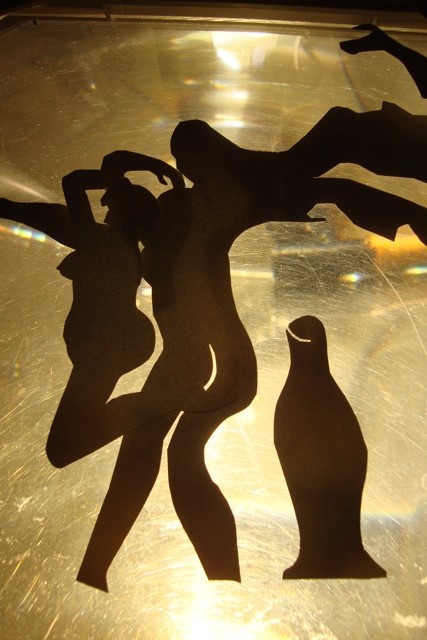
It’s the attic I want to write about. I’m convinced that there’s a party going on up there every night. There are dozens of paintings stored in racks plus about twenty larger-than-life cardboard cutouts based on all the corrupt developers, lawyers and politicians I have been dealing with over the years - along with their wives, girlfriends, goons, etc. Since I haven’t come through with the performance piece I promised them years ago, I am convinced they put on plays of their own at night when I am asleep, A Brechtian theater ensemble in my attic! I’m especially suspicious when I see them in a different order than they were on a previous visit.
All in all, it’s a pretty lively crowd up there.

In addition, the low eaves at either side of the roof are perfect for storing things that don’t have much height. That’s where I keep the dozens of supermarket boxes I filled with satirical figures set in photocopied backdrops of pre Urban Renewal Stamford. Those are the ones an art critic once said that “if that’s what people actually look like,” she would “fall on her ballpoint pen.” I hate to tell her, but that’s what people actually look like.


Frankly, it’s ok with me if my creations want to party. I would prefer that they go out in the world, party in museums and galleries, but if that isn’t going to happen –at least in my lifetime  - then let them have a good time up there by themselves. I can sleep through anything!

Saturday, January 2, 2016

POST #111: FORM FOLLOWS F---- UP Or, The Scientific Principle of Limited Sloppiness


My sculptor son Ned and I got into a lively conversation a couple of nights ago on neatness in the workspace. The guys in his shop have a sign on the wall that says “Form Follows F----UP. Rosie, my blog helper, tells me the server who sends out my blog does not tolerate lewdness of any kind and will probably take me off line. Anyhow, the principle is pretty obvious: too much messiness and you can’t think straight; too neat and you inhibit creativity. I once walked out of an art teaching job (to scary unemployment) in New York City because the Principal of the school insisted that the room be perfectly neat at all times, no spilled paint, no paper scraps on the floor. Better “hand to mouth” I decided than to try to teach art in such an inhibiting environment.

Of course, the need for order varies from artist to artist and the nature of his or her work.  I’m somewhere in the middle of neatness: too much mess and I can’t think straight, can’t find anything. Too neat and the principle of “limited sloppiness” kicks in and I can’t create. There are artists, however, like the Dutch painter, Piet Mondrian, who lived in New York City during World War II. Mondrian was known for maintaining an immaculate studio in his apartment, coming to work every day wearing a suit and a tie, spending months on each painting, carefully moving a limited repertoire of shapes and lines around the canvas.

I find I work best (like most artists) in a state of middle neatness. I recently passed the threshold of acceptable messiness and was forced to hire someone to help me get “organized.” I won’t give out her name because she’s so busy she barely has time to help me. I learned my lesson with Felipe, my handyman, gardener, carpenter, canvas stretcher and “homme de ménage.” He’s better than a husband because you can tell him what to do. I made the mistake of sending him to a friend, who sent him to all her friends and now I have trouble getting him.


Anyhow, X got me organized in two afternoons. We took four carloads of waste matter to the dump, and I never missed any of it. I now need her again because the creepy crud is coming back. Nature abhors a vacuum. Her methods are simple: she is very autocratic, insists that I concentrate on what we are doing, doesn’t allow me to drift off into my usual creative revery. That’s the problem of trying to make order on your own; you get distracted. “Oh, that’s where such and such is! Let’s see what I can do with it”. The “neatanizer” snaps me back to attention and the job gets done. We still have half a studio to go (probably another four loads to the dump?) but she has been too busy to get to me. Apparently, there are lots of artists around who desperately need her services.” While there’s truth to “form follows f---- up,” the problem is getting one’s workplace to the point whereyou can create without distraction …(and keep it there!) 

Friday, December 18, 2015

POST #110: TO CRITIQUE OR NOT TO CRITIQUE

My artist friends rarely ask me to critique their work and I never offer anything more than ”Gee. That’s great! I like what you’re doing!” On the rare occasion when I am directly asked, I hem and haw and mutter platitudes. I just don’t feel I have the right to impose my vision on someone else’s work. I also don’t like other people telling me what to do. The last time I listened to an artist friend, it took six months to undo the damage. The only exception is my friend Elena who can actually take a brush to my canvas and make it better.


Teaching art in general is a treacherous business. You can learn the basic techniques in a couple of hours, but the remaining time you need to become proficient has to be done on your own. When we first moved to Fairfield County, decades ago, there were at least a half dozen hunky older men who taught bored housewives “watercolor.” All their students’ work looked alike, a bag of tricks taught to them by their mentor. Mostly, the guys were serial seducers; while it was amusing to watch them in action, it was  hard to consider them serious artists or art teachers.

The only one I knew who had any idea of what he was doing was a Hungarian emigre painter named Victor Candell. He wasn’t a particularly good artist himself but he was a master teacher, the Sigmund Freud of the suburban art scene. He taught a weekly seminar at the Greenwich Arts Center to a bunch of conservative matrons desperate to find their inner creative souls. I was the oddball in the class; I had actually studied art, but after being a ‘stay-at-home’ mom for several years, needed some help getting back up to speed. Candell taught me what abstraction really meant (I had been painting “Abstracts” for over a decade with no idea of what I was actually doing). I would never be doing the work I’m doing now without his guidance so many decades ago.

Anyhow, what brings this all to mind is an image a friend recently sent me of her latest work, an excellent example of Action Painting. She asked me to critique it, something I rarely, if ever, do. What could I say that would be helpful, not throw her off track the way someone had done to me decades ago?  After pondering a while, I realized what she needed to do and rather than my telling her, she had to get there on her own. The only way for that to happen was for her to work, day in and day out, until her conscious mind no longer controlled her hand and her subconscious, with all the suffering she had been through in her life, came through in her art. I gave her the example of Rothko who managed to infuse abstraction with intense emotion. That was where she needed to go, but I couldn’t tell her how; she had to get there on her own.

By the way, my suggestion that she plumb her emotional depths puts her completely out of step with the current art world.  There are no serious painters of note today. Everything is a gimmick, a spoof, a take off, a marketing ploy. If you want to know where today’s artists learned their craft, I recommend Sarah Thornton’s book of essays, Seven Days in the Art World, published in 2008, The piece de resistance is The Crit which describes a seminar at CalArts in Los Angeles, (one of the top art schools in the country) in which MFA students present their work for collective critique. I’m not going to tell you what happens; you have to read it for yourself, especially if you want to understand the current scene.


Anyhow, the bottom line is, I really hesitate to critique or advise anyone; I have enough trouble managing myself.  Can you imagine Cezanne asking Bonnard whether he should keep on painting apples? Maybe try pears?