Friday, December 18, 2015

POST #110: TO CRITIQUE OR NOT TO CRITIQUE

My artist friends rarely ask me to critique their work and I never offer anything more than ”Gee. That’s great! I like what you’re doing!” On the rare occasion when I am directly asked, I hem and haw and mutter platitudes. I just don’t feel I have the right to impose my vision on someone else’s work. I also don’t like other people telling me what to do. The last time I listened to an artist friend, it took six months to undo the damage. The only exception is my friend Elena who can actually take a brush to my canvas and make it better.


Teaching art in general is a treacherous business. You can learn the basic techniques in a couple of hours, but the remaining time you need to become proficient has to be done on your own. When we first moved to Fairfield County, decades ago, there were at least a half dozen hunky older men who taught bored housewives “watercolor.” All their students’ work looked alike, a bag of tricks taught to them by their mentor. Mostly, the guys were serial seducers; while it was amusing to watch them in action, it was  hard to consider them serious artists or art teachers.
The only one I knew who had any idea of what he was doing was a Hungarian emigre painter named Victor Candell. He wasn’t a particularly good artist himself but he was a master teacher, the Sigmund Freud of the suburban art scene. He taught a weekly seminar at the Greenwich Arts Center to a bunch of conservative matrons desperate to find their inner creative souls. I was the oddball in the class; I had actually studied art, but after being a ‘stay-at-home’ mom for several years, needed some help getting back up to speed. Candell taught me what abstraction really meant (I had been painting “Abstracts” for over a decade with no idea of what I was actually doing). I would never be doing the work I’m doing now without his guidance so many decades ago.

Anyhow, what brings this all to mind is an image a friend recently sent me of her latest work, an excellent example of Action Painting. She asked me to critique it, something I rarely, if ever, do. What could I say that would be helpful, not throw her off track the way someone had done to me decades ago?  After pondering a while, I realized what she needed to do and rather than my telling her, she had to get there on her own. The only way for that to happen was for her to work, day in and day out, until her conscious mind no longer controlled her hand and her subconscious, with all the suffering she had been through in her life, came through in her art. I gave her the example of Rothko who managed to infuse abstraction with intense emotion. That was where she needed to go, but I couldn’t tell her how; she had to get there on her own.

By the way, my suggestion that she plumb her emotional depths puts her completely out of step with the current art world.  There are no serious painters of note today. Everything is a gimmick, a spoof, a take off, a marketing ploy. If you want to know where today’s artists learned their craft, I recommend Sarah Thornton’s book of essays, Seven Days in the Art World, published in 2008, The piece de resistance is The Crit which describes a seminar at CalArts in Los Angeles, (one of the top art schools in the country) in which MFA students present their work for collective critique. I’m not going to tell you what happens; you have to read it for yourself, especially if you want to understand the current scene.


Anyhow, the bottom line is, I really hesitate to critique or advise anyone; I have enough trouble managing myself.  Can you imagine Cezanne asking Bonnard whether he should keep on painting apples? Maybe try pears?

Friday, December 11, 2015

POST #109: IT’S ALL IN MY STARS

I’m a typical Libran and I can’t make up my mind. I keep weighing pros and cons, should I or shouldn’t I? The only reason I ever got married is that a man came along (a Taurus) who took matters into his own hands and made the decision for me. After our third date, he announced that we were going to San Francisco on our honeymoon. No wiggle room there. He was a psychologist, not an astrologer but, without even knowing my “sign”, he knew what needed to be done. If he had left it to me, I’d still be deciding.

What’s so interesting is that for many years most of my women friends were Librans (born September 23 to October 22nd), in fact, two of my best friends had the exact same birthday, September 29th and several others were a week or two apart. We often had a Libra birthday party together and were remarkably similar in personality and interests. Of course, I don’t believe any of this. I didn’t believe in Tarot either, but a year and a half ago, when the Tarot card reader in California suggested I write about art, I started this blog and it was the best advice I ever received!

Most of the Librans I know are nice people; we’re very attractive to men (not to brag) and confident (ahem). The only problem we all have is this damn indecisiveness. Always weighing the pros and cons and having a terrible time making a decision. I need to make two major business decisions in the next few months and am struggling. I even wish I had a man around to make them for me; that’s how desperate I am!

The other problem we Librans have is that we have to keep our lives (scales) balanced and will go to great extremes to avoid conflict or disruption. When my life is in balance, I fly; when the scales are out of kilter, I can’t function. Since this is theoretically an “art” blog, this brings us, obviously, to the Principles of Design, the course every art student takes at the very beginning of his or her training). We are taught that a work of art needs to be “balanced,” however, unlike a math problem or an algorithm, there is no correct answer; it’s all intuitive, not mechanical. But a work of art,  like a seesaw, won’t work properly unless it is balanced, whether symmetrically or asymmetrically, either way, doesn’t matter. It seems to be intuitive, unexplainable, built into our DNA. I can look at a painting or a photograph and “know” immediately whether it is balanced or not. Maybe, all it needs is some more dark paint in the right-hand corner. Ah! Now it’s “right”.

Anyhow, let’s go back to Librans. Perhaps there is some perfectly good scientific explanation why we share personality traits. Maybe it’s as simple as being born a certain time of the year; as the days grow colder and shorter, more time is spent bundled up indoors. There’s a certain amount of hibernation that takes place in the months following our birth and maybe this causes changes in our neurological structure? Someday, science will solve the mystery of astrology and it may turn out to be the weather on earth, not the alignment of the stars. 

Friday, December 4, 2015

POST #108: STUCK IN A STYLE


 One of the problems (which I fortunately don’t have to face) of being successful in the art world is that you get stuck in a style. The examples are legion of dealers asking artists to stay with the work that sells. Don’t blame the dealer; it’s a business to him. He’s not interested in the artist’s immortal soul; he just wants to pay the rent. There’s nothing worse that being told to do “another” painting like the one you just finished because there’s a customer for it. If that’s okay with you, then you should consider yourself a commercial artist, a perfectly legitimate trade, where you know from the getgo that you are providing a product and the buyer is determining the nature of the product. Most artists I know look upon a painting as a problem to be solved and once having solved it, are reluctant to keep repeating themselves.

On the other hand, most great artists loved variations on a theme. Like Mondrian, Cezanne, Monet; once they got something going, they were perfectly happy to explore it the rest of their lives. There are some artists, however who create problems for their dealers by wanting to stop painting the work the collectors want and move into new territory. Jackson Pollock was the perfect example. It’s sad when a successful artist gets boxed in my his success: mortgages, employees, property in Majorca, wives, ex-wives, disturbed children, all take their toll. Selling is no longer an option; it is a necessity….and that’s the end of any change or growth. They become captives of the market and their work deteriorates. Of course, like Basquiat or Modigliani, some artists solve the problem of repeating themselves by dying young, before boredom sets in.

This is a long-winded way of getting to the subject of today’s blog. If you haven’t been to my studio lately, you are in for a big surprise. The ditzy ladies, the corrupt politicians, the sultry sirens, the greedy developers have all been replaced by a kind of serene surrealism. That’s because I am finally moving away from my “day job” as a preservation consultant. I still plan to write a newsletter, but I am done with the battles. However, it was the battles that gave me subject matter, my “edge” and without them, I don’t feel the need for social criticism. The same thing happened to George Grosz when he fled the Nazis and came to America. He loved it here. He lost his raison d’etre and. I, having lost my “opposition” have retreated from reality into the unconscious. I’m now painting dreamy surrealist streetscapes, the kind of work people actually want to LIVE with. Although this is not my goal (never has been), I have been selling most of my recent work and find myself trying to talk people out of buying so I will have something for future shows. I tell them to tape their names on to the back of the canvases so they can claim the pieces later. My prices are still pathetically low (I’ve never been good at business) but before, I couldn’t give the work away. While people may have admired the old, satirical paintings as “art,” they didn’t want to be reminded in their living rooms the foibles of a corrupt society (which it still is) and that success usually goes to the least worthy among us, not the best.

I like the fact that as my life has changed, my artwork has changed with it. Every once in a while, I find myself going back to satire: pulchritudinous females, corrupt real estate developers and politicians. The results make me smile, but there isn’t the need for “revenge” any more. My head is literally in the clouds, painting imaginary cities that float in space. 

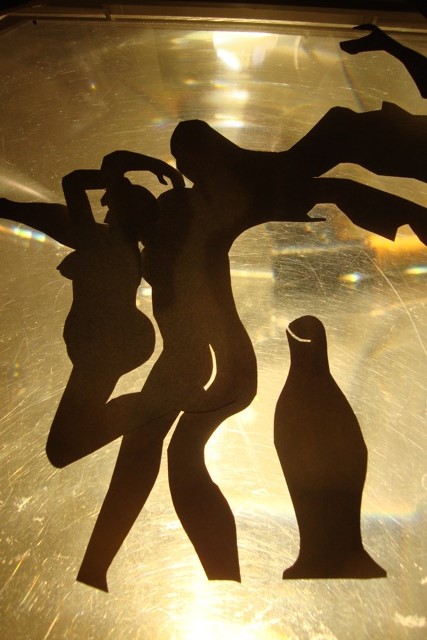
P.S. In bed at night, watching TV, I cut figures out of black kraft paper and in the morning, paste them onto paper plates (“Arte Povera” style) or put them on the overhead projector where they can be enlarged to monumental size. I have nothing to sell, but they are so breathtaking, I don’t care.
I haven’t missed a meal yet. 

Saturday, November 21, 2015

POST # 107: BREATHE!

I don’t have to tell my readers, life is full of distractions. When was the last time any one of us had more than ten minutes to think without a text message coming through, a phone call or an e-mail that HAD to be answered AT ONCE!
Creative thinking requires concentration. You need to get into a state (now fashionably referred to as “flow”) where ideas filter through the unconscious mind and come out in new forms. I am often asked what I listen to when I am painting and my questioner is usually surprised to hear “Nothing. I require total silence.” There’s no such thing as “background noise” to me; any noise, especially the human voice, is a distraction.

Do I get lonely? Sure, but not while I’m working. I have to get into a creative zone before anything new and interesting emerges and that requires time and isolation. It might take a couple of hours before my hand relaxes enough to turn out something worthwhile. I have no idea how someone can paint in a communal art studio where you hear other people’s conversation and music. At least, I never could. The best solution I know is the old Paris cafĂ© where artists worked in solitude, (often, like Chagall and Picasso, locking their doors against visitors) and then spent the evening chatting with friends and colleagues. Studio visits (if any) were carefully planned so as not to disrupt “the flow.”

We live in a world of multi-tasking, another way of describing doing many things, not AT once – that is physically impossible - but rapidly switching from one activity to another. In addition, we are subject to endless distractions and become easily addicted to our electronics. You have only to watch people at a party sneakily checking their iPhones while appearing to converse with you. What are they expecting that can’t wait an hour or so? An invitation to be Cinderella at the Ball? It takes enormous discipline (which I don’t have) not to check my e-mail with ever increasing frequency. We start out being “connected” for good reasons: young children alone at home, your spouse needs to be picked up at the train, etc. and before you know it, you are hooked, an electronic junkie!

I find it interesting that  “mindfulness” and “meditation” classes are so popular nowadays, teaching people how to turn off the babble in the brain and just shut down. When the mind begins its chatter, you are told to “let it go,” empty your consciousness of thoughts and worries. “Breathe,” the teacher says, “Breathe.” It’s amazing how relaxing it is to just sit and breathe in and out; you become aware of how tense and ‘wired up’ you are. In one of the articles I read before writing this blog, the author suggested just letting your tongue hang out for a minute or two. She admitted you would look ridiculous, but said it was a great way to unwind. I may give it a try. If not, I’ll just “breathe.” The world isn’t going to miss me while I’m catching my breath.


P.S. During the hour or so I spent writing this, I received four phone calls, three from telemarketers. I didn’t answer any of them, but it was hard to get back my flow. Next time, I’ll turn everything off (or at least, I’ll try).

Friday, November 13, 2015

POST #106: STARTERS AND FINISHERS

One of my sons recently “accused” me of having ADD or ADHD. “I don’t!” I protested, “I’m a creative. I just happen to have a short interest span.” Today, I would probably be medicated. I was fortunate to attend a public school in New York City that was one of five singled out to experiment with the teaching methods of the philosopher, John Dewey, the so called “Activity Schools.”  I was a perfect candidate since their dictum of “Learning by Doing” suited my lack of interest in rote memorization. I hated the highly disciplined teaching style I encountered later on in an all-girls Junior High School that was run like a nunnery. My husband (a clinical psychologist) was fond of saying that, given my hatred of routine and repetition, he had no idea how he lasted as long with me as he did (fifty years).

Anyhow, I’ve been fortunate enough to be able to tame my tendency to wander when I have to and can apply my rear to the seat of a chair when it is required. I agree with my husband that my short interest span is not pathological, but simply a different way of doing things. If properly channeled, my creativity is enormously useful, especially if I can partner with someone who likes to fuss with the details. When I write something that needs to be technically perfect like the newsletter I write, I hand it over to my friend Colin who whips it into shape, not a comma out of place. And with artwork, the guy who rakes my leaves has turned out to be a perfect studio assistant; he can stretch canvases like nobody else I have ever seen.

Many years ago, I had a friend who owned a highly successful state-of-the-art engineering company with about thirty employees. He had a theory about hiring that worked very well for him and, now that I think about it, works for me. He hired people whom he designated as “Starters” or “Finishers.” These qualities rarely appeared in one person and by not demanding that his employees be able to do both well, he got the best out of them. The Starters had brilliant, innovative ideas, but got bogged down and unhappy when they had to deal with details and implementation. On the other hand, there were people who were great at follow-through, but couldn’t come up with a creative idea if their life depended on it. By separating the functions and giving them to people who were good at what they did, he came up with some amazing innovations in the field of telecommunications and his company did exceedingly well.


The point is, I’m a Starter. I’m good at coming up with new ideas, but get bored when the creative part is over. I’m happiest when accompanied by a “Finisher,” somebody who likes the details, getting everything right. I have no patience for follow up and, as my parents used to complain, I have no “sitz-fleisch,” meaning, no meat on my behind.

Friday, November 6, 2015

POST #105: WHERE HAVE ALL THE HUMANISTS GONE?

I was originally going to write about the humanist tradition in art. You know. Giotto, Brueghel, the Social Realists of the Thirties, going all the way back to the ancient Greeks. But then, after perusing recent art magazines and going into a bunch of New York art galleries, I don’t know that there’s much humanism around. There’s a lot of minimalist, abstract painting: big, decorative canvasses that look good in loft apartments, as well as some large-scale public environmental art plus a good deal of Pop-ish, cartoon-derived stuff. There’s also a slew of larger-than-life, digitally modified photographs and paintings that look like photographs. Not much that could be defined as humanist but then, why should there be? To parody the old theater cliche: Humanism (especially in the form of social satire,) is what closes on Sunday. There’s no market for it.

When the rare occasions when figurative art does appear and images of people are used, the work is either incredibly angry and distorted or so sentimental and clichĂ©  that I cringe – end up wishing the artist had stuck to colored squares. So, where have all the humanists gone, the ones who genuinely care about people? The same place as everywhere else in our society, replaced by cheap thrills and computer-driven technical tricks. To explain what’s going on, you have to look at the “art market” (and it is nothing more than a market.) Who buys art anyhow? . The “Common Man” spends his hard-earned dollars on 60” flat screen TVs. He doesn’t need ‘pitchas’ on the wall? And, if he does feel a desire for some real art, he can always pick up a giclee print for a coupla bucks at WalMart. Looks just like a genuine Van Gogh, down to the 3D brushstrokes.


Through most of the history of art, work was produced for the aristocracy and the church. They were sophisticated buyers, quite knowledgeable (and self promoting). Except for brief periods in the Netherlands during the 16th and 17th centuries, the activities and feelings of ordinary people were rarely depicted until the mid-1800s, when they appeared as part of broader, socialist- based movements that extolled the Working Class and their everyday life. Humanism showed up in German Expressionism after World War I and during the Great Depression in the thirties. Remnants survived into the 1950s but got knocked out for good during the McCarthy political era where any art that sympathetically depicted  “real” people was suspected of ties to radicalism.


There’s no trace of humanism in the art world today, except for isolated throwbacks with leftover ideals and an out of date interest in the real (not electronic) world. Conspicuous consumption and meaningless art is expressive of the time we live in and is the order of the day. Even a die-hard humanist (like your blogger) finds herself moving away from reality and into the safety of dreams. 

Thursday, October 29, 2015

POST #104: THE STATE OF ART


I finally got down to the Lower East Side to catch up with the latest art district in New York City. I’ve lived through Greenwich Village (my teens and twenties), Soho (my thirties), Chelsea (my forties), Noho etc. in more recent decades. The area is supposedly the last bastion of affordable gallery and studio space in Manhattan proper although gentrification appears to have won another battle. In addition, an  ever-expanding Chinatown has taken over large chunks of the area and while certainly  clean and respectable, lacks the colorful grunginess I once loved.

Anyhow, I was told to check out the new epicenter of the New York Art world, my old stomping ground, the Lower East Side. I was informed I wouldn’t recognize it. Truthfully, I didn’t, and I didn’t much like what had taken its place. It was as if all the life had been sucked out of the area; the buildings are mostly the same but the old zest isn’t there. Even the art scene is surprisingly lifeless. The once-crowded streets are now largely empty, even of cars (no reasonably-priced places to park) and the jumble of tacky businesses that gave the area its character is gone.  We saw only a few fabric outlets, (a reason for past visits); the antique (junque) stores on Allen Street have disappeared as have the flophouses on the Bowery and their haunted clientele. Only a handful of restaurant equipment stores that once lined the street remain. No more “outlets’ that sell discount bags and name-brand clothing. With few exceptions, gone are the ethnic food stores and restaurants. Even the lively signage that once characterized the area has been cleaned up, with only a few “ghosts” from the past still around. It was obvious, ethnic cleansing of a cultural sort has taken place. I never thought I’d live to say this but the Lower East Side has become “boring” and I still have the photos I took fifty years ago to prove it.

Since the purpose of the trip was not to revisit old haunts but to check out the latest in the New York art scene, I am sad to report that that too was a disappointment. The only reasonably interesting work was at the New Museum on the Bowery. And most of that wasn’t new but done around 25 years ago. The museum featured a multi-floor exhibit by a Chicago/LA eccentric accumulator, Jim Shaw who specializes in collecting amateur art from thrift shops plus some oversized cartoon-y installations of his. On the ground floor was a room full of extremely “anxious” paintings by another Chicago artist (whose name I forget) that dates from the ‘70s. Is this the “New” museum’s idea of cutting edge? Isn’t there anything current they want to show? But, based on what we saw elsewhere in the neighborhood, probably not. The only exciting exhibit we came across was by an Aborigine artist from Australia. Talk of anxious-looking art, these win the prize. Thousands and thousands of tiny dots in radiating patterns, but at least well done and original. We went to a dozen galleries and frankly, I don’t even remember what we saw.

Next we’ll try Brooklyn. Maybe there’s something worthwhile there. One of my sons has an artist friend called Chico MacMurtie who bought an abandoned church in Red Hook where he builds life-size performing robots. They recently played at his wedding.

Now, that sounds interesting!